General Description
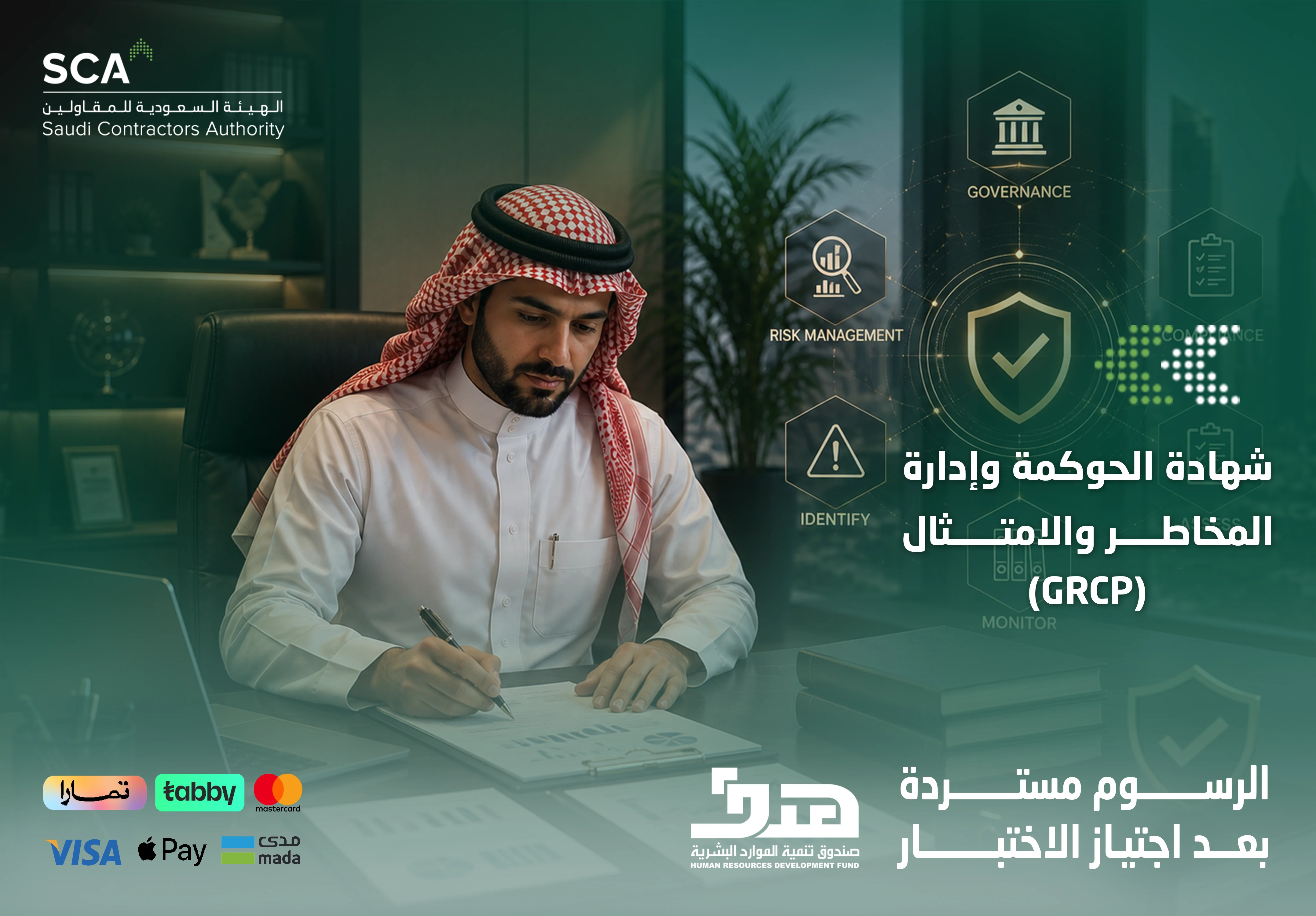
The Governance, Risk and Compliance (GRCP) Certification is a professional development opportunity for individuals working in governance, risk management, and compliance, as well as professionals seeking to build a comprehensive understanding of GRC concepts and their application in modern business environments.
The certification focuses on key principles and practices related to governance, risk management, and compliance, helping participants understand how these areas work together to support informed decision-making, strengthen organizational oversight, and manage risks and compliance requirements in a structured manner.
Through the Saudi Contractors Authority Open Learning Platform, participants can prepare for the GRCP certification through a remote training program delivered over 10 training days. The program is designed to provide learners with the knowledge needed to understand the GRC framework and apply its principles within the workplace.
The program is suitable for professionals looking to strengthen their capabilities in governance, risk management, and compliance, whether they aim to enhance their existing expertise or support their career development in GRC-related roles.
The program also includes the possibility of recovering the training cost, subject to the applicable terms and conditions, upon successfully meeting the certification requirements.
Start your professional development journey in Governance, Risk and Compliance through the Saudi Contractors Authority Open Learning Platform and strengthen your knowledge to meet the needs of modern professional environments.
The Goals
The Governance, Risk and Compliance (GRCP) Certification aims to develop a comprehensive understanding of GRC and help participants understand the relationship between governance, risk management, and compliance within an organization. The program also focuses on developing skills that support organizational oversight, informed decision-making, and structured management of risks and regulatory requirements.
Key objectives of the GRCP Certification include:
-
Understanding the relationship between governance, risk management, and compliance and the role each plays in supporting organizational objectives.
-
Recognizing the importance of GRC principles in strengthening transparency and organizational oversight.
-
Developing the ability to identify and analyze operational, financial, strategic, and technology-related risks.
-
Understanding professional frameworks and practices related to governance, risk management, and compliance.
-
Developing the skills needed to understand compliance requirements and align them with internal policies and procedures.
-
Becoming familiar with monitoring and control tools used to evaluate performance and improve organizational processes.
-
Developing the ability to identify weaknesses and areas of risk exposure and recommend appropriate corrective measures.
-
Strengthening the ability to prepare governance, risk, and compliance reports that support management decision-making.
-
Improving readiness to address regulatory and oversight requirements within organizations.
-
Preparing for the GRCP examination by developing the knowledge required across the certification's key subject areas.
Through the Saudi Contractors Authority Open Learning Platform, participants can follow a structured learning path designed to strengthen their GRC knowledge and improve their readiness for the certification requirements and the needs of modern professional environments.
Target Auidence
The Governance, Risk and Compliance (GRCP) Certification is designed for a wide range of professionals working in governance, risk management, compliance, and related oversight functions. It is particularly relevant to individuals whose roles require an integrated understanding of GRC principles, including:
-
Senior and Executive Leaders: Professionals seeking to strengthen their ability to analyze risks and support strategic decision-making.
-
Internal Audit and Accounting Professionals: Individuals involved in internal controls, governance reporting, compliance, and assurance activities.
-
Governance, Risk, and Compliance Professionals: Specialists working in GRC functions within organizations who want to strengthen their professional knowledge.
-
Risk Management Specialists and Managers: Professionals looking to expand their expertise in applying governance principles and integrating them with risk management practices.
-
Regulatory and Oversight Professionals: Individuals working in roles involving policy compliance, internal procedures, and regulatory requirements.
-
Professionals Developing a Career in GRC: Individuals seeking specialized knowledge to support career growth or transition into governance, risk management, and compliance roles.
The certification is particularly suitable for professionals who want to develop an integrated understanding of governance, risk management, and compliance and apply relevant GRC concepts across different organizational environments.
The Features
The Governance, Risk and Compliance (GRCP) Certification helps professionals strengthen their knowledge and skills in GRC and develop a clearer understanding of how governance, risk management, and compliance work together to support organizational objectives and improve institutional practices.
The key benefits of the GRCP Certification include:
-
Strengthening GRC knowledge: Develop a comprehensive understanding of the relationship between governance, risk management, and compliance and how they interact within organizations.
-
Developing professional skills: Build knowledge that supports a more structured and systematic approach to governance, risk, and compliance matters.
-
Connecting concepts with practical application: Understand how GRC principles can be applied to analyze challenges and support organizational practices.
-
Supporting professional development: Add a specialized qualification to your professional profile if you are pursuing a career in governance, risk management, or compliance.
-
Enhancing decision-making capabilities: Develop an integrated perspective on organizational risks and regulatory requirements to support informed management decisions.
-
Improving understanding of the regulatory environment: Recognize the role of policies, controls, and monitoring mechanisms in strengthening compliance and organizational oversight.
-
Understanding the integrated GRC framework: Build a knowledge foundation that helps connect organizational objectives, risks, and compliance requirements.
The certification is offered through the Saudi Contractors Authority Open Learning Platform as part of a structured training path designed to strengthen participants' knowledge of governance, risk management, and compliance and prepare them for the certification requirements.
Topics
The Governance, Risk and Compliance (GRCP) Certification covers a range of topics designed to help participants understand the GRC framework and the relationship between governance, risk management, and compliance within organizations. Key topics include:
-
Governance, Risk, and Compliance Fundamentals: Understanding the core principles and leading practices related to these areas and how they can be managed in an integrated manner.
-
Integrating Governance, Risk, and Compliance: Understanding how GRC components can be connected to support organizational objectives, performance, and oversight.
-
Risk Management and Compliance Strategies: Exploring approaches for identifying and assessing risks and developing appropriate strategies to manage and reduce their potential impact.
-
Internal Controls: Understanding the role of internal control systems in monitoring organizational processes, supporting objectives, and improving operational effectiveness.
-
Regulatory Requirements Management: Understanding the importance of monitoring regulatory obligations and aligning them with internal policies and procedures.
-
Supporting Decision-Making: Understanding how risk, compliance, and internal control information can provide valuable insights for informed management decisions.
This content helps participants build a structured foundation in governance, risk management, and compliance while strengthening their readiness to apply GRC concepts within professional environments.
Learning outcomes
The Governance, Risk and Compliance (GRCP) Certification helps participants develop professional skills that support the understanding and application of GRC principles within organizations. Key skills that can be developed through the program include:
-
Applying governance and compliance principles: Understanding how governance and compliance concepts can be incorporated into organizational policies, procedures, and practices.
-
Effective risk management: Developing the ability to identify, assess, and address risks in ways that support business continuity and organizational objectives.
-
Risk and compliance analysis: Analyzing risks and regulatory obligations and identifying areas that may require corrective or preventive action.
-
Integrating GRC components: Connecting governance, risk management, and compliance within an integrated framework that supports organizational strategy and objectives.
-
Professional reporting: Developing the ability to organize and communicate governance, risk, and compliance information in a clear manner that supports decision-makers.
-
Supporting management decisions: Using risk, compliance, and internal control information to provide clearer input into organizational decision-making.
-
Addressing regulatory challenges: Developing a structured approach to understanding and managing regulatory requirements within the workplace.
These skills provide a professional foundation in GRC and can be applied across various roles related to governance, risk management, compliance, internal audit, and organizational oversight.
Requirements And Conditions
To obtain the Governance, Risk and Compliance (GRCP) Certification, participants need to complete the relevant training requirements and meet the requirements for the certification examination. The main requirements include:
- Enroll in the training program: Register for the preparatory program offered through the Saudi Contractors Authority Open Learning Platform and complete the required training content.
- Prepare for the examination: Study the key topics and subject areas covered by the GRCP program and prepare for the final assessment.
- Pass the GRCP examination: Complete the international GRCP examination and meet the passing requirements established by the awarding organization.
Participants are advised to review the latest official certification requirements before registration, as eligibility criteria and examination procedures may vary depending on the awarding organization and the applicable program version.
FAQs
The Blog
Are you looking for a professional pathway that develops your knowledge of governance, risk management, and compliance and brings these disciplines together within an integrated framework? The GRC Professional (GRCP) certification offers an opportunity to explore GRC principles and develop the skills associated with applying them in the workplace.
This article covers the key information about the GRCP certification, from its topics, requirements, and exam format to its cost, awarding body, and related professional fields. It also outlines the remote GRCP training program we offer at the Saudi Contractors Authority Academy to help you prepare for the exam.
What Is the GRC Professional (GRCP) Certification?
The GRC Professional (GRCP) is a professional certification focused on developing knowledge of governance, risk management, and compliance concepts and practices within organizations. It helps professionals understand how these disciplines connect and support management and decision-making.
The certification covers essential topics such as governance frameworks, risk identification, assessment, and treatment, alongside compliance with applicable regulations, policies, and procedures. It also helps participants understand the relationship between these areas and their influence on organizational operations and decisions.
The GRCP certification is suitable for governance, risk, and compliance professionals, as well as individuals seeking to expand their knowledge of these fields and strengthen their ability to address risks and regulatory requirements in the workplace.
If you want to prepare for the GRCP certification exam, the Saudi Contractors Authority Academy offers a training program that helps you develop your knowledge of governance, risk, and compliance. Contact us to learn about the program and registration process.
The Importance of GRCP Certification in Developing Professional Skills
The GRCP certification helps develop an integrated understanding of GRC disciplines. Its professional value is reflected in several areas of workplace practice, including:
-
Understanding the relationship between governance, risk, and compliance: It helps participants recognize how these disciplines connect and influence organizational decisions and operations.
-
Developing risk management skills: It strengthens the ability to understand, assess, and address potential risks within a structured framework.
-
Increasing awareness of regulatory requirements: It helps participants understand the importance of complying with regulations, policies, and procedures relevant to an organization’s activities.
-
Supporting decision-making: It provides a knowledge foundation for analyzing the risks and requirements associated with organizational decisions.
-
Improving professional communication: It builds familiarity with terminology and concepts shared by governance, risk, and compliance teams, supporting collaboration across departments.
-
Expanding knowledge of GRC practices: It provides a broader view of practices used to manage governance, risk, and compliance in an integrated way.
-
Supporting professional development: It adds a specialized professional credential to a career profile and supports those seeking to build careers in governance, risk management, and compliance.
The certification’s value therefore lies in the GRC knowledge and skills professionals develop, beyond the addition of a professional title.
The Relationship Between Governance, Risk Management, and Compliance and the Importance of Integration
GRC brings together governance, which establishes direction and responsibilities; risk management, which helps address uncertainty; and compliance, which focuses on meeting relevant requirements and rules. Integrating these disciplines provides a connected perspective for decision-making and business management.
The following table explains the roles of the three disciplines and how they work together:
| Discipline | Role Within GRC | Relationship With the Other Disciplines |
|---|---|---|
| Governance | Establishes direction, responsibilities, decision-making mechanisms, and oversight. | Guides risk management and compliance in alignment with organizational objectives. |
| Risk management | Identifies, analyzes, and addresses risks to support the achievement of objectives. | Provides information for governance decisions and helps prioritize compliance activities. |
| Compliance | Monitors relevant requirements, controls, and policies and addresses noncompliance. | Connects with governance through responsibilities and oversight, and with risk management through noncompliance risks. |
Integration occurs when these disciplines operate within a shared framework: governance establishes direction, risk management addresses uncertainty, and compliance supports adherence to requirements and controls. This integration is one of the areas emphasized by the GRCP certification in its approach to GRC.
GRCP Certification Topics and Training Areas
The GRCP certification focuses on topics that help participants understand GRC components as interconnected disciplines and apply them to support management, decision-making, and responses to risks and regulatory requirements. Key topics include:
-
Governance, risk management, and compliance concepts.
-
Corporate governance principles and the roles and responsibilities of different parties.
-
Risk management, including risk identification, analysis, and assessment.
-
Risk treatment strategies and monitoring mitigation measures.
-
Compliance management, regulatory requirements, policies, and procedures.
-
Enterprise risk management (ERM) and aligning risks with strategic objectives.
-
Internal controls and their role in mitigating risks and supporting compliance.
-
Managing policies, procedures, and associated controls.
-
Risk and compliance reporting and information, and their role in supporting decision-making.
-
Integrating governance, risk, and compliance and establishing a unified approach to GRC activities.
The GRCP certification brings these complementary disciplines together to develop a broader understanding of how governance, risk, and compliance connect within an organization.
Requirements for Obtaining the GRCP Certification
According to OCEG’s requirements, the GRCP certification does not require a specific academic qualification or particular professional experience. Candidates need to register for and pass the exam to earn the certification. Training helps them prepare for the exam and study governance, risk, and compliance topics more systematically.
GRCP Certification Exam Details and Preparation
Preparing for the GRCP certification requires understanding the exam format and the topics it assesses. The exam is delivered online, lasts two hours, and consists of 100 questions. Candidates must answer 70 questions correctly to pass. Preparation should therefore focus on understanding governance, risk management, and compliance concepts and the GRC Capability Model on which the exam is based.
To prepare for the exam, focus on:
-
Reviewing governance, risk management, and compliance concepts.
-
Studying the GRC Capability Model used as the basis for the exam.
-
Understanding the exam format and practicing time management.
-
Using a structured training program to support review and preparation.
Organizing your studies and understanding the GRC model can help you approach the GRCP certification exam with a clearer preparation plan.
Cost of the GRCP Certification Program in Saudi Arabia
The GRCP certification program at the Saudi Contractors Authority Academy costs SAR 7,300. The program is delivered remotely, and the price includes training and exam entry fees, bringing preparation requirements together within one program.
If you are looking for training to help you prepare for the governance, risk, and compliance certification, we offer a remote GRCP program that includes exam entry fees. Contact us for registration details and program dates.
The GRCP Certification Awarding Body and Professional Recognition
The GRCP certification is associated with OCEG, the organization that developed the GRC Capability Model and its related professional certification. It is important to distinguish between the certification awarding body and the training provider:
-
Awarding body: OCEG.
-
Certification field: Governance, risk management, and compliance.
-
The Academy’s role: Providing training and exam preparation.
-
Certification issuance: Handled by the awarding body, rather than the training provider.
Career Opportunities After Obtaining the GRCP Certification
The GRCP certification is relevant to professional fields that rely on knowledge of GRC principles. It may therefore suit professionals seeking to develop their careers in governance, risk management, and compliance. Related fields include:
-
Corporate governance: Supporting the implementation of governance frameworks and organizational policies.
-
Risk management: Identifying and assessing risks and monitoring approaches to addressing them.
-
Compliance: Monitoring relevant requirements, controls, and policies.
-
Internal audit: Contributing to audit and oversight activities according to the role’s responsibilities.
-
Internal controls: Supporting the implementation of controls and procedures and monitoring adherence to them.
Job titles and requirements vary by sector, employer, experience, and qualifications. The certification adds professional knowledge and a credential, but it does not guarantee a specific job.
How Long Is the GRCP Certification Valid, and How Is It Renewed?
After passing the GRCP exam, the certification remains valid until the next renewal date of the holder’s OCEG Pro All Access Pass membership. Continued validity therefore depends on maintaining membership and meeting the specified renewal requirements. These include:
-
Renewing Pro membership by the required dates.
-
Completing eight hours or credits of continuing education annually, starting in the second year.
-
Ensuring continuing education activities relate to governance, risk, and compliance or the certification topics.
-
Monitoring OCEG requirements and renewal dates to keep the certification active.
GRCP holders therefore do not need to retake the exam at each renewal. They maintain the certification through an active Pro All Access Pass membership and by meeting annual continuing education requirements after the first year.
Why Choose the GRCP Certification Program at the Saudi Contractors Authority Academy?
Choosing a suitable GRCP preparation program helps you study governance, risk management, and compliance concepts systematically, with an emphasis on the areas you need to understand before taking the exam. Through the Saudi Contractors Authority Academy’s GRCP program, you can benefit from:
-
Structured training content: Study governance, risk, and compliance concepts as interconnected disciplines.
-
GRCP exam preparation: Review the concepts and topics associated with the certification.
-
An integrated understanding of GRC: Explore governance, risk management, and compliance within a connected training framework.
-
Professional skills development: Strengthen your knowledge of risk management, compliance, and control practices.
-
Remote training: Participate in the program without traveling to a training venue.
-
Workplace application: Understand how GRC concepts relate to organizational decisions and operations.
-
Professional development support: Expand your knowledge of governance, risk management, and compliance to support career development in these fields.
-
Easy access to programs: Use the platform to explore available programs, review their details, and register online.
These features allow you to study for the GRCP certification through the Saudi Contractors Authority Academy’s platform and benefit from specialized training within a professional environment focused on developing capabilities and skills.
Steps to Register for the GRCP Program Through the Platform
To register for the GRCP certification program, begin your application through the Saudi Contractors Authority Academy’s platform and provide the information needed for communication about the program. Registration steps include:
-
Visit the GRCP certification program page on the platform.
-
Select the registration option and enter the required information, including your full name, email address, and mobile number.
-
Complete the registration procedures and contact us to learn about the next program steps.
-
Begin the remote training program, which consists of 30 training hours delivered over 10 training days.
-
Prepare for the GRCP exam and complete the awarding body’s certification requirements.
These steps allow you to begin registration for the governance, risk, and compliance training program and prepare for the certification requirements.
The GRC Professional (GRCP) certification offers a professional development option for individuals seeking to expand their knowledge of GRC concepts and understand the relationship between governance, risk management, and compliance within organizations. Studying its topics also helps build a more integrated understanding of risk identification and treatment, alongside adherence to policies and regulatory requirements.
Through the Saudi Contractors Authority Academy’s GRCP program, you can study the certification concepts and prepare for the exam through structured remote training, supporting your professional skills development and strengthening your knowledge of governance, risk, and compliance.